Introduction
Coral reefs represent one of Earth’s most complex and valuable ecosystems, supporting approximately 25% of marine biodiversity while protecting coastlines from erosion. For engineers, these underwater “cities” present a fascinating systems challenge that combine fluid dynamics, materials science, and robotics.
The fundamental engineering problem involves monitoring, analysing, and repairing delicate biological
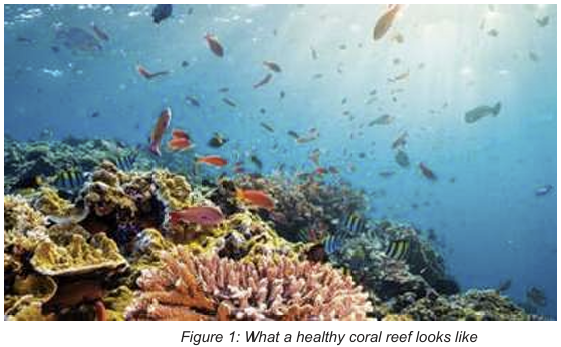
structures in a dynamic, corrosive environment where visibility is limited and access is challenging. With climate models predicting catastrophic reef loss by 2050, the engineering community is responding with technological solutions. These innovations range from advanced sensor networks to autonomous repair systems, all designed to operate in one of Earth’s most demanding environments. Figure 1 shows a healthy coral reef colony and its inhabitants
Understanding Reef Decline Through an Engineering Lens
From the perspective of system engineering, coral bleaching represents a cascading failure with clear parallels to industrial systems. Thermal stress acts as the primary input that disrupts the coral-algae symbiosis, a critical biological process. This leads to energy depletion, representing output failure, followed by structural degradation that mirrors material failure in engineered systems.
The secondary impacts on dependent species create a network collapse
similar to infrastructure failure. Modern monitoring approaches employ distributed sensor arrays that industrial engineers will recognise as underwater IoT networks. These sensor networks integrate with satellite uplinks to create comprehensive monitoring systems covering entire reef ecosystems, functioning much like SCADA systems in industrial plants
Machine Vision and AI for Underwater Structural Health Monitoring
The application of computer vision to coral health assessment follows a workflow familiar to quality control engineers. The process begins with data acquisition using ROV-mounted cameras and hyperspectral imagers, followed by preprocessing steps that correct water column distortion and stitch images together.
Feature extraction algorithms identify individual polyps and segment colour patterns, while convolutional neural networks classify health status with increasing accuracy. Engineers have successfully adapted proven deep learning architectures for marine applications, including Mask R-CNN for coral instance segmentation and vision transformers for large-area classification. Long/short-term memory networks now enable growth pattern prediction, helping conservationists anticipate future reef conditions.
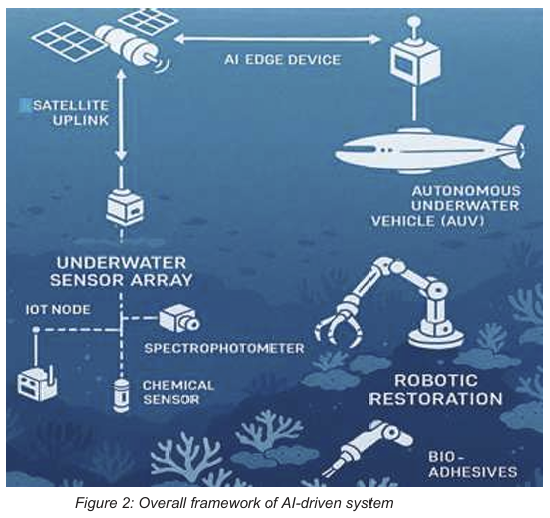
To enable real-time analysis during dives, engineers have implemented model quantization techniques that allow these sophisticated algorithms to run on edge devices with limited processing power. Figure 2 shows an example of an AI-driven integrated coral reef monitoring system.
Robotic Systems for Precision Underwater Intervention
The development of autonomous underwater vehicles for reef conservation borrows heavily from terrestrial autonomous systems. These platforms utilise simultaneous localisation and mapping (SLAM) algorithms adapted for unique challenges of water column navigation, along with Doppler Velocity Logs for dead reckoning in environments where GPS is unavailable.
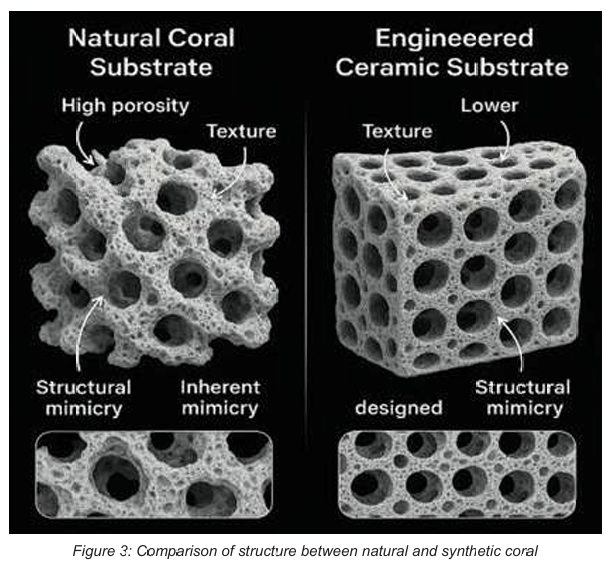
The modular payload bays allow for mission-specific tooling, much like industrial robotic systems. The end-effector design presents particularly intresting materials challenges, requiring soft robotics gripper capable of handling fragile coral fragments without damage. Engineers have developed specialised bio-adhesives for underwater bonding and pioneered the use of 3D-printed ceramic substrates with engineered porosity that mimics natural reef structures. See Figure 3
Industrial-Scale Approaches to Reef Restoration
There have been significant advances in automated coral propagation systems which apply biotech principles to large-scale reef rehabilitation. These systems feature computer-controlled LED arrays which optimise light spectra for coral growth, along with automated water quality management system which maintain ideal conditions. Microfluidic systems now enable precise sorting and distribution of coral larvae, increasing survival rates dramatically.
Additive manufacturing has emerged as a powerful tool for creating artificial reef structures at scale. Engineers have developed robotic clay extrusion systems for immediate deployment and algorithmically generated designs which replicate natural reef complexity. The development of recyclable concrete formulations with pH buffering capabilities represents another significant materials engineering breakthrough.
Engineering Roadmap for Reef Recovery
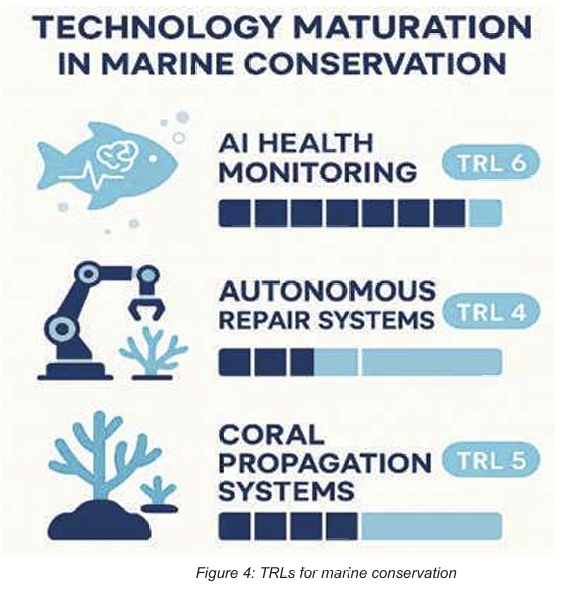
Technology Readiness Levels (TRLs) in marine conservation reveal both progress and opportunities. Current AI health monitoring systems have reached TRL6, with autonomous repair systems at TRL4 and
mass propagation technologies at TRL5. There are standardisation challenges which require unified data protocols, along with benchmark datasets for algorithm validation and interoperability standards for robotic systems. These developments will enable the scaling of conservation efforts to match the magnitude of the challenge. Figure 4 indicates the TRLs for marine conservation in relation to coral reefs colonies as it stands.
Conclusion
For the engineering community, coral reef restoration represents a grand challenge that intersects nearly every engineering discipline while offering opportunities for technological innovation, with applications beyond marine conservation. The solutions being developed, from advanced computer vision pipelines to autonomous marine robots, demonstrate how engineering expertise can address critical environmental challenges.
Engineers interested in contributing can engage with open-source reef monitoring projects, participate in industry-academic partnerships for field testing, or explore cross-disciplinary collaborations with marine biologists. As these technologies mature, they offer potential to not just slow down the rate of reef decline, but also to actively reverse it through engineered solutions which work in harmony with natural systems.

Author
Ir. Ts. Prof. Dr. Mohd Rizal Arshad
Expert in underwater systems technology, marine robotics, and advanced sensing methods.
Original Publication
This article is adapted from a published feature in JURUTERA, The Institution of Engineers Malaysia (October 2025).
[Download PDF] (upload the PDF to Media Library and link here)